by Tom Patri | May 11, 2015 | TPGS Tips to Improve Your Golf Game

The Golf Stroke has Two Basic Elements 1) Geometry (geometry = shape) – golf consists of an elliptical inclined circle (orbiting clubhead) and an adjustable radius-(left arm club) and the ground 2) Physics of rotation (physics = speed) – the swinger slings the club (centrifugal force powers) The hitter pushes the club (right arm muscular thrust…
READ MORE
by Tom Patri | May 5, 2015 | TPGS Tips to Improve Your Golf Game
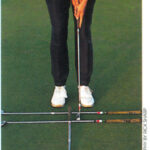
(Part 2, Conclusion) Continued from blog entry – “Keeping Your Putter on Line (Part 1)” . The Putting Laboratory Lay down two clubs 3 to 4 feet from the hole along a putting line that is straight and slightly uphill. The clubs should be parallel and just wide enough apart to accommodate the length of…
READ MORE
by Tom Patri | May 5, 2015 | TPGS Tips to Improve Your Golf Game
(Part 2) The inclined plane controls the clubshaft. The flat left wrist controls the clubface. The pressure points control the clubhead (drag). . . . . . . . . . . . . . . . . . . . . YOU CAN GET A FREE VIDEO GOLF LESSON FROM TOM PATRI TO…
READ MORE
by Tom Patri | Apr 29, 2015 | TPGS Tips to Improve Your Golf Game
The mechanical definition of a golf stroke is: The hinge action of an angular motion on an inclined plane … a gyroscopic motion … with clubface control. . . . . . . . . . . . . . . . . . . . . YOU CAN GET A FREE VIDEO GOLF…
READ MORE
by Tom Patri | Apr 29, 2015 | TPGS Tips to Improve Your Golf Game
(Part 1) When working with students to improve their putting, I have them fraction their focus. I break putting into two basic elements: distance and direction. Let’s talk direction, which encompasses two major components–clubface position and path. Both are critical to success. Clubface position at impact has everything to do with how your ball begins…
READ MORE
by Tom Patri | Apr 20, 2015 | Tom's Blog, TPGS Tips to Improve Your Golf Game

. 1) Set Goals – Have a Road Map 2) Warm Up – Stretch 3) Practice With a Purpose 4) Practice to Know Distances (NS vs EW) 5) Close your Eyes and Learn to Feel Motion 6) Be Patient 7) Trust Your Work 8) Practice After Play 9) Review Goals 10) Keep a Notebook 11)…
READ MORE